
One more video at the end of the text.
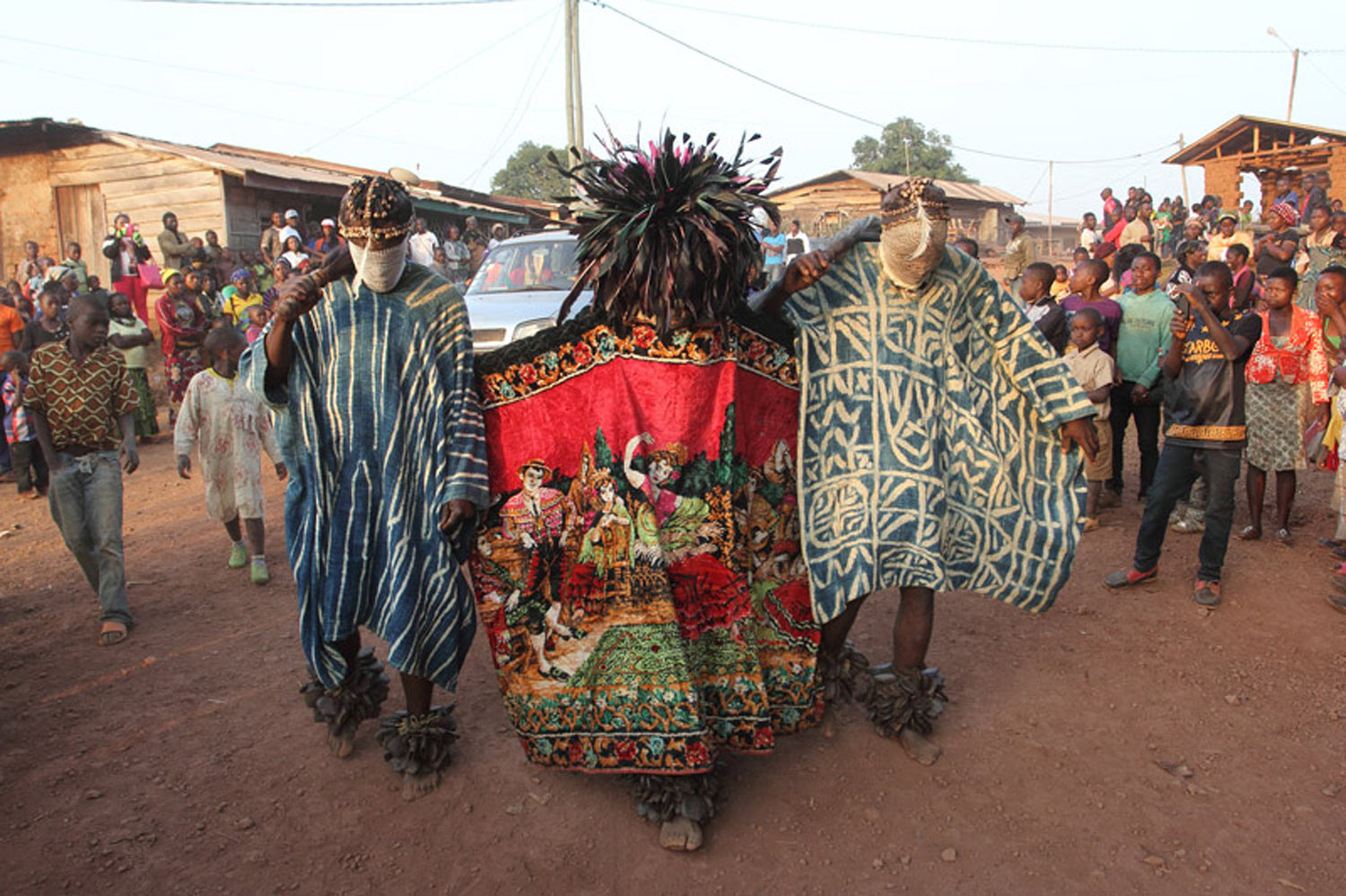
The Kingdom of Oku and the grasslands of Cameroon are rich in traditional art. The numerous ethnic groups, societies and secret societies know a variety of impressive masks and costumes. These are often decorated with appliqués, which in turn are small works of art. These can be carved miniatures, but also leather packs with secret medicines, pearls or organic substances from the animal kingdom.
The latter are often found in royal jewelry, which uses these elements to adapt the power of the wild. Examples are baboon teeth and ivory balls on a necklace or drinking vessels made of antelope horn, which was refined with elaborately carved decorative elements. Among the healers, one can find fine ivory figures, which are used in obstetrics, among other things. Especially the masterpieces of the bronze casters enjoy international recognition.
Another important group are the cult objects that have to do with the power of bush spirits and ancestor worship.
Kwifon – the secret society of clan leaders
Kwifon is the most powerful secret society in Oku, the highest kingdom of the Cameroonian grasslands. Together with King Fon Sentieh II, it plays the most important political role there. The Fais, heads of large family clans, who have advisory and regulatory functions and represent the interests of their respective clans, belong to this society.
Kwifon serves to support and protect the king and, together with him, to ensure the welfare of the people in every conceivable way. The work of Kwifon is fully accepted because the Federation exercises a controlling function and prevents the ruler from going it alone. Thus the king must consult Kwifon on all important decisions, because the last word is always spoken by the collective.
Kwifon also exercises jurisdiction and is responsible for the initiation of most religious ceremonies. For example, deceased members of Kwifon are buried with special ceremonies using ritual masks. The secret society also plays a major role in the persecution of thieves and witches. It is feared by all who wish to harm the people or the king and is respected by everyone.
Chong Grating Drum
The Chong Secret Society occupies a special position among the secret societies of the Kingdom of Oku. It is a warriors’ alliance against damaging forces, whose members do not wear masks, but instill fear and respect in outsiders and evildoers with the mysterious sounds of their instruments. These include a wooden horn and a water horn, which consists of a calabash filled with water and a bamboo cane.
Above all, Chong is known for its characteristic rubbing drum. This instrument, which like the others, with the exception of large palace ceremonies, is played mainly at night, is said to protect against witchcraft and to warn the villagers not to leave their homes at night. The users of the rubbing drum moisten their hands with palm wine before playing and use small bamboo sticks to make the drum speak.
Cannibal bowl of the witch coven
This more than 100-year-old bowl originates from the Kingdom of Oku in the Cameroon Grasslands and was used in rituals by members of various witch covenants. The witches used the bowl to offer human sacrifices to the forces of darkness.
The blood of the sacrificed person was reserved for the damaging powers, but their flesh was eaten by the witches at the climax of the ceremony by mutual agreement. The bowl, which was punishable by death for possession as well as participation in the rites, was smuggled out of Oku many years ago and stored in the neighboring countries.
The owner contacted Henning Christoph to give him the bowl for the museum’s operation, where it now bears witness to the long gone cannibalism among the Cameroonian witch’s covenants.
Kheghebcio – the witch hunters
The secret society Kheghebcio is responsible for the protection against witches in the Cameroonian grasslands and for fighting them. Kheghebcio is armed for dealing with the evil forces by a suitably dark and deterrent robe, which is covered all over with amulets and magic packages full of secret medicines.
Each application bears witness to a case in which a witch could be arrested or a witch’s spell banished. The respect for this costume, which may only be worn by initiates on important occasions, is accordingly great. All others, especially the women, are strictly forbidden to touch the robe, because of the fear of infection by evil forces.
“Kheghebcio” means “full beard” in the Okus language, alluding to the bast beards of the masks. Another typical sign of Kheghebcio is a fruit that is carried in the mouth by the wearers of the magic costume during rituals. This is Solanum aethiopicum, the “Ethiopian egg fruit”.
It belongs to the nightshade family and is associated with the Ngang Medicine Society of which Kheghebcio is a part.
Samba – the healing power of women
The special feature of samba medicine is that all important steps in the preparation and application of medicines must be carried out by women. These are initiated in the cult and organized in networks.
Because one of Samba’s tasks is to fight witchcraft, Samba is often referred to as the wife of Kheghebcio. Samba’s power in this respect is at least as feared and includes the right to punish, but also the knowledge of highly potent herbal defensive poisons, for example against harmful spells.
Another, equally important aspect of Samba’s power is the knowledge of medical treatments for infertility. These have always been successfully used by childless women. In addition, Samba ensures the smooth burial of the dead with special rituals and the use of secret plant mixtures. Their use ensures that the souls of the dead find peace instead of returning to terrorize the remaining families.
The fact that Samba is sometimes referred to as a “military secret society” is due to the fact that some of their specially composed remedies can give warriors strength – even invincibility.
Ngang – The secret medical society
The most important medical society in Oku and in several other tribes of the Cameroonian Grasslands is Ngang. The word “Ngang” comes from the Bantu languages and means in large parts of the Congo as much as “medicine man” or “fortune teller”.
In the Cameroonian secret society Ngang, all healers and oracle readers of the tribes living here gather to serve the protection and well-being of the people together. In Ngang, traditional magic medicine and centuries-old healing arts of the region are concentrated, such as the knowledge of rare medicinal plants and their application.
The declared goal of Ngang is to promote the health and prosperity of the population, but the society also provides for the defense against witchcraft. It keeps enemy forces in check with secret ceremonies and is responsible for supplying other, smaller societies with medicine.